Monday, 9 August 2010

Shark Savers debuts anti-shark finning campaign in Hong Kong :: Wetpixel.com

Shark Savers debuts anti-shark finning campaign in Hong Kong


Shark Savers debuts the "Say 'No' to shark fin soup" Campaign in Hong Kong at the Diving and Resort Travel Expo

Hong Kong, July 16, 2010. Shark Savers launched the "Say 'no' to shark fin soup" campaign in Hong Kong at the Diving Resort & Travel Expo that opens today and extends through July 18, 2010. Shark Savers, a key participant in the Expo’s theme of marine conservation, will encourage people to stop eating shark fin soup as a means to protect sharks and improve ocean health.

According to Michael Skoletsky, Shark Savers' Executive Director, "Shark populations are being destroyed at a devastating pace throughout the world, primarily due to high consumption levels of shark fin soup. We are bringing the message of the protecting sharks by not eating the soup to Hong Kong, one of the epicenters for shark fin trade and consumption."

Sharks are the apex predators of the seas and have been shown to play an important role in maintaining the healthy balance of other species throughout the ocean food chain.

Hong Kong has long been the center of the shark fin trade. However, there has been a growing movement of people rejecting shark fin soup in this dynamic city. The Shark Savers campaign provides grassroots support to this emerging trend by empowering people to take a Pledge to not eat shark fin soup and to carry the message to their friends, family, local restaurants and businesses and their places of employment.

The “Say ‘no’ to shark fin soup” campaign is an extension of an effort pioneered by WildAid in China. Since 2009, Shark Savers has been partnering with WildAid in China and elsewhere, an effort that includes a powerful advertising message with spokesperson Yao Ming, urging people to stop eating shark fin soup. Yao Ming is Houston Rockets NBA Basketball star, owner of the Shanghai Sharks, and flag-bearer for China’s 2008 Olympic team.

The leader Shark Savers’ volunteers at the Expo, Jonn Lu, has set an ambitious goal -- to get 20,000 Expo visitors to Pledge not to eat or serve shark fin soup. "The Hong Kong Shark Savers team is excited to be part of this growing movement to take shark fin out of soup and keep sharks in the oceans where they can do so much good."

Shark Savers will be encouraging Expo visitors to sign the Pledge at a table at the Expo entrance, at Booth G52 and at its web site. More about shark fin soup, Shark Savers, and the pledge, may be found at http://www.sharksavers.org/sharkfinsoup

About Shark Savers:

Shark Savers is an international non-profit organization founded in 2007 dedicated to shark conservation. It focuses on reducing the consumption of shark fin soup, serving as the voice of sharks for the maligned species, and creating effective shark sanctuaries to protect sharks.

About The Hong Kong Diving, Resort & Travel Expo (the “DRT Show”):

The DRT Show runs from July 16-18, 2010 at the Hong Kong Exhibition Centre. It is one of the largest and most sought after events focused on diving, resort and travel held in Asia, open to the trade and consumers. It is the only Dive Expo supported by Hong Kong Underwater Association (HKUA) and China Underwater Association (CUA). The Expo is expecting an estimated 45,000 to 50,000 visitors over 3 days.

Contacts:

Julie Andersen
julie.andersen@sharksavers.org
Ph:+1.917.546.6618

Mary O'Malley
mary.omalley@sharksavers.org
Ph: +1 305 632 3688

Banners / stickers:


Shark Savers debuts anti-shark finning campaign in Hong Kong :: Wetpixel.com: "- Sent using Google Toolbar"

Thursday, 5 August 2010

Manta Ray, Kadavu, Fiji

This Manta stayed with us for about 10 mins and kept circling around.

A great experience that I would recommend to anyone. Thanks to the team at Matava.

Wednesday, 4 August 2010

Remote paradise - TripAdvisor

Matava is the perfect place to experience the beautiful part of Fiji that is Kadavu.

The location is great, overlooking the lagoon and then to the outer reefs in the distance.

The friendly atmosphere created by the owners and the incredible staff (led by the incomparable Maggie) feels just right and the communal dining tables allows a relaxed, informal interaction with the other guests over the fresh and varied food.

The Bures are reasonably simple but very nicely done with decent amenities (lights, running water, proper toilet, shower etc.) considering that it is an eco-resort and very remote.

There is plenty to keep you as active or inactive as desired. Snorkelling is great between the resort and nearby island and others guests said the diving nearby is 1st class. Other activities include boat trips, private beach picnics, surfing and a real highlight of visiting the nearby school, village and waterfall.

The island of Kadavu is a window into the Fiji of the past, untouched by many of the historical colonial influences or present political contrivances.

We really cannot recommend Matava enough if you are looking for something different and beautiful. Set your expectations accordingly (remembering it is an eco-resort and a long way from anywhere) and you will not be disappointed.
Remote paradise - Review of Matava - Fiji's Premier Eco Adventure Resort, Kadavu Island, Fiji - TripAdvisor:

Tuesday, 27 July 2010

Amphiprion pacificus, a new species of clownfish discovered in Fiji


Underwater photos of Amphiprion pacificus, adult, approximately 60 mm SL, Fiji. Photo by J. Jensen

Amphiprion pacificus is a new species of anemonefish discovered by Gerald R. Allen, Joshua Drew and Douglas Fenner described in the latest issue of the Aqua, the International Journal of Ichthyology. The researchers discovered A. pacificus in the Wallis Island and Tonga in the western Pacific with other underwater photographs revealing its presence on coral reefs of Fiji and Samoa.

The team notes the new taxon is nearly identical in appearance to A. akallopisos from the Indian Ocean. The two share common characteristics — typically pinkish-brown and grading to orange or yellow on the lower portion of the head and side, with a similar white stripe extending from the head along the dorsal midline ending at the caudal fin. Genetic testing does reveal show A. pacificus is more closely related to A. sandaracinos (Orange Skunk Clownfish) hailing from the Western Australia and Indo-Malayan region. The physical differences between the common orange skunk differs from A. pacificus with its more uniform orange coloration and the white forehead stripe extends onto the upper lip. The team also noticed what appears to be differences in the number of soft dorsal and anal rays on each species.

If you’re interesting in reading the entire paper, you can purchase it online in PDF format from Aqua.

Amphiprion pacificus, a new species of clownfish discovered in Fiji

Scuba Diving Fiji

Monday, 26 July 2010

Divers and Dental Professionals Combine Work and Passion for Scuba Diving Through Fiji Project

By Mark Fischer
Owner, HydroSports Dive and Travel

Most people think of Fiji as an island paradise. But four airports, three types of aircraft, 19 time zones and 30 travel-hours from HydroSports (Keizer, Oregon) is the village of Kadavu Koro. Remote by both distance and time villagers have almost no access to medical or dental care. Located on the Island of Kadavu, Kaduva Koro is home to about 300 people.


I have visited Fiji 12 times over the past 10 years. Last October I stayed at the Waidroka Bay Resort on the big island, Viti Levu. Waidroka Bay, a beautiful resort with all the amenities, is closely connected to a local village. During my stay I was able to visit the village and local primary and secondary schools and received an education about the availability of health care at the village level. What I learned was that while care is readily available in cities, at the village level, care is scarce.


Returning from that trip I decided to pioneer a Dental Mission. I partnered with Coach Ramey Stroud, a Mill City diver, and Stuart Gow, Director of the Matava Eco-Resort on the island of Kadavu. Together we identified dates for our trip, solicited the cooperation of Air Pacific, the national airline of Fiji, the Fiji Islands Hotel and Tourism Association and the Fiji Ministry of Health. Salem Hospital generously shared information about our trip with their staff.


I traveled with Dr. Mike and Mrs. Carrie Litchfield and Dr. Sean Hanson of Salem and Jim and Gina Jepsen from Ione, Oregon. Dave Beard from Tasmania met us at Matava and joined our team.

Air Pacific allowed us each to bring an extra 50 pounds of medical gear. Mike and Sean had received hundreds of toothbrushes, toothpaste samples and dental supplies from their suppliers. Mike brought a portable dental station as well.


Our arrival at Matava was met with excitement. Maggie, the Fijian concierge, let us know that he had shared the news of the American dentists arriving three weeks earlier with the village council. He had made arrangements for us to visit the village the next day to meet with the Chief, the Director of the School (whose classroom’s we planned to use for the clinic) and the village nurse (representative of the Ministry of Health). We took an open boat to the village, walked past sleeping dogs, feeding chickens, children playing, men unloading cinderblocks and women washing clothes.


We sat on the floor of the Chief’s home. Maggie and the chief chatted, laughed, gestured at me and Sean. The Chief spoke firmly. Maggie stood up and gestured to us. We stood as well. “We must now visit with the Director of the School” Maggie said.

Again we sat on the floor, laughter, gestures and quizzical looks. Maggie stood. We stood. “We need to speak with the nurse now” Maggie told us.


Walking uphill toward the rain forest we stopped outside the nurse’s home. We learned that the village nurse is the representative of the Ministry of Health and has significant power in the community. Speaking directly to us, she expressed concern that she had not been notified by the government of our mission. I assured her that all forms requested, dental licenses, diplomas and work history information had been sent to the Ministry offices in Suva, the capitol. A smile! She shook our hands and told us we were welcome to provide dental care for her community.


As we walked back to the boat, Maggie explained that even though the resort and village know that American Dentists were coming, culturally, it was necessary for us to personally visit and request permission to provide free dental care for the community.


Our plan was pretty simple; breakfast, a two tank dive then lunch. We opened the clinic at 1:30 and treated patients until dark. Power in the classroom was limited to a single neon lamp powered by a new generator. We had come equipped with flashlights for diving and lighting up teeth.


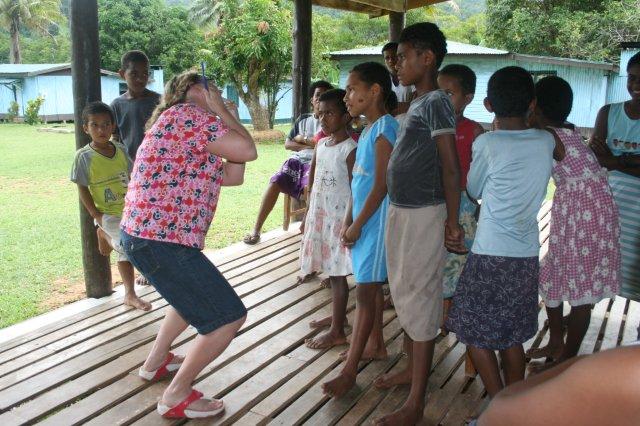
Each afternoon the number of patients grew as word of our clinic spread. The third day we planned to hold an instructional clinic for the village children to share toothbrushes and toothpaste. Carrie Litchfield, an elementary school librarian in Salem was our point person. Using humor, laughter and smiles, Carrie warmed up the kids, taught basic oral hygiene and brushing technique and passed out over 200 toothbrushes and tubes of toothpaste.

We knew that dental care in the village was extremely limited. We learned that a boat ride to Vunisea, location of the regional hospital an hour away, has a cost of nearly a week's wages each way.


During our stay we had the opportunity to serve nearly 200 villagers from Kadavu Koro. Carrie taught 75 children how to brush their teeth. Numerous rotted, damaged and decayed teeth were removed, mostly from adults, a few from children.


We met many wonderful people during our visit to Kadavu Koro and our stay at the Matava Eco-Resort. We dove the Great Astrolabe Reef most mornings and provided dental care in the afternoon. Our Mission provided an opportunity to provide care for those in need and an education about preserving one's teeth to the children of the village.


I'm not fully back from Fiji; I keep asking myself what I would be doing 19 hours from now if I was in Kadavu Koro.


I plan to return to Fiji next year with dentists, optometrists, doctors and nurses to continue the tradition of combining compassion and passion. Care to join me?

Comments from Mike, Carrie, Sean, Gina and Jim can be found at: www.hydrosports.com/MatavaMemories.html

Tuesday, 20 July 2010

Friday, 16 July 2010

Fiji…: Undercurrent 04/2010

Debbie Pasich (San Diego, CA) dived the Astrolabe Reef with Mad Fish Dive Center at Matava Resort in November. “Dive sites were anywhere from a 10- to 30-minute ride and surface intervals. Outside the reef there was always an ocean swell, between two and three feet. Inside the reef was calm but because the weather was unseasonably windy, we usually had some surface chop. I dove Manta Reef twice, with no less than ten mantas total. At Eagle’s Rock, at least 25 white-tip, black-tip and gray reef sharks of various sizes were schooling together in the reef inlet. Japanese Gardens had a beautiful assortment of soft corals. Besides the largest variety of butterfly fish I’ve ever seen, I saw a dolphin, a Napoleon wrasse, a sea snake, several lionfish, octopus, turtles, giant clams, eels, clownfish and stunning nudibranchs. With traditional thatched bures tucked into the mountainside of Kadavu Island, Matava is a beautiful place to get away from it all.

The newest (honeymoon) bure at the top of the hill (94 stairs of various sizes to climb) has an absolutely spectacular view. It’s an eco-resort and a majority of the power is supplied by solar so leave your hairdryer at home. Maggie, the resort host, has a unique style of hospitality and makes sure that you feel welcome. All the homemade breads were terrific. Lunches were varied and dinners ranged from satisfactory to quite good with excellent flavors. Soups were extraordinary. This close to New Zealand you will likely be served lamb for at least one dinner.” (www.matava.com).

Fiji…: Undercurrent 04/2010